 Run FS RMRS Dry Ravel Model–California
RavelRat ... 10-m DEM elevation data for California.
Model/interface use
- model inputs
Run Description Northern Latitude (oN) N or S bounding latitude;
enter in decimal degrees or degrees-minutes-seconds, eg. 34o25'55"
Range: 32.282 to 42.131oNSouthern Latitude (oN) N or S bounding latitude;
enter in decimal degrees or degrees-minutes-seconds
Range: 32.282 to 42.131oNWestern Longitude (oE) W or E bounding longitude;
Range: -124.556 to -113.956oEEastern Longitude (oE) W or E bounding longitude;
Range: -124.556 to -113.956oEBurn Impact Depth (mm) Range: 0 to 10 mm Mean Stem Diameter (m) Range: 0 to 0.5 meters Bulk Density (kg/m3) Range: 1100 to 1600 kgs per cubic meter Static Friction Angle (o) Range: 26 to 36 decimal degrees Vegetation Density (stem/m2) Range: 0 to 20 stems per square meter Kinetic Friction Angle (o) Range: 20 to 36 decimal degrees - input limits
- watershed size 0.0025 km2 to 1.2 km2
- active output
- click elevation plot for cell elevation
- mouse over deposition plot for deposition amounts
- click in deposition plot to generate W-E and N-S elevation transects with color-coded deposition
- mouse over production plot for production amounts
- click in production plot to generate W-E and N-S elevation transects with color-coded production
- mouse over histogram bars to show count
- click histogram axis to show bin count
- Internet Explorer 8: Print Preview > Page Setup > Paper Options: [X] Print Background Colors and Images
- Mozilla Firefox 4: Print Preview > Page Setup > [X] Print Background (colors and images)
How to use the elevation, deposition, and production data files
- Paste into Excel file for custom analysis
- These are ESRI Arc/Info ASCII Grid files. Instructions to use with Arc View and Arc GIS
| Before the fire | Model initialization | Iterations |
|---|---|---|
 |
 |
 |
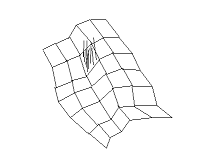
| Grid cells may have vegetation with loose soil caught behind stems
burn impact depth, vegetation density, and stem diameter affect amount of soil available to travel |
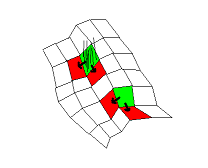
(Green) cell may produce sediment, deposited in neighboring (red) cells as sediment starts moving depending on static friction angle and cell slope
static friction angle and slope affect production |
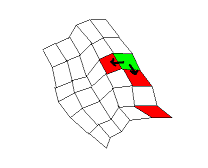
Cells may continue to be a source; ravel will move between cells – depending on the kinetic friction angle and the cell slope – until particles reach the angle of repose
kinetic friction angle and slope affect deposition |
Technical documentation ...
Citation:
Hall, David E.; Robichaud, Peter R.; Miller, Mary Ellen; Xiangyang Fu. 2011. RavelRAT-CA. Online at <https://forest.moscowfsl.wsu.edu/BAERTOOLS/ravel/ravelrat-ca.html>. Moscow, ID: U.S. Department of Agriculture, Forest Service, Rocky Mountain Research Station.